

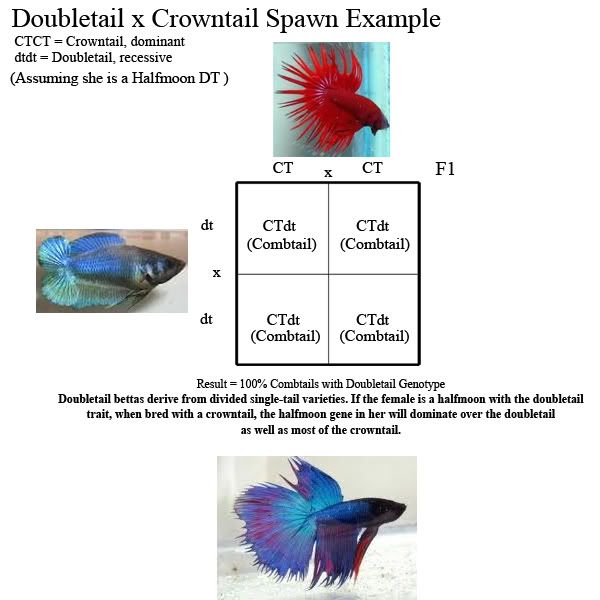
Heeeeey all. :-D Took the time to create a how-to diagram on breeding the illusive double-tail-crown-tail betta. Personally I think they look pretty cool, but it's a mighty long journey there. See below, as I explain step by step.
![Image]()
Alright, let's begin.
Step One:
Alright, so you've decided you want to take a leap and try to start a line of DTCTs. One thing to keep in mind is that there are different kinds of double tails- halfmoon double tails, delta tail double tails, plakat double tails, etc. In this example, we are assuming the female is a halfmoon doubletail, who is a DT genotype as well as phenotype (meaning, she is both physically and genetically a doubletail, or Doubletail Homozygous.) You also manage to get a crowntail father, as pictured above. When you breed the two, as seen in the punnett square example, you will get 100% single tail bettas, since the double tail gene is recessive.
Now, the crowntail gene in bettas is what we call intermediar, meaning it will show its unique characteristics in offspring most of the time. (Double tail is also intermediar, it ususally gives the offspring broad dorsals, thicker bodies and at times longer anal fins.) In this case, the offspring of this spawn will most likely be 100% Combtail bettas, or single tail bettas that have ray extension.
These offspring carry the Doubletail genotype from mom, so they are Crowntail-Doubletail Heterozygous.
Still with me? :lol:
This brings us to Step Two:
![Image]()
Now that you have a batch full of adult combtails several months later, some with more ray extension than others, you are ready to begin the next step.
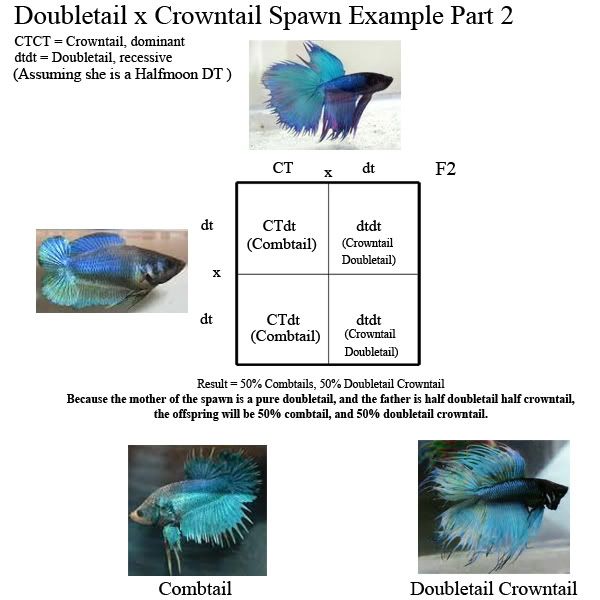
You take the best-looking male from the offspring bunch, and you breed him back to his mother, the doubletail. Since he has doubletail in his genes from mom, according to the punnett square the offspring will be 50% combtail, and 50% CTDT. (However, experiments have shown that generally less than 25% of the actual spawn will be CTDT because they are two intermediar traits- in this case, Mr. Punnett isn't all too accurate.)
Doubletail Crowntails are not only a mouthfull, but they are somewhat rare and striking in appearance. Hopefully I have inspired you to start your own line, and equipped you with the proper knowledge to tackle it.
;-)
Alright, let's begin.
Step One:
Alright, so you've decided you want to take a leap and try to start a line of DTCTs. One thing to keep in mind is that there are different kinds of double tails- halfmoon double tails, delta tail double tails, plakat double tails, etc. In this example, we are assuming the female is a halfmoon doubletail, who is a DT genotype as well as phenotype (meaning, she is both physically and genetically a doubletail, or Doubletail Homozygous.) You also manage to get a crowntail father, as pictured above. When you breed the two, as seen in the punnett square example, you will get 100% single tail bettas, since the double tail gene is recessive.
Now, the crowntail gene in bettas is what we call intermediar, meaning it will show its unique characteristics in offspring most of the time. (Double tail is also intermediar, it ususally gives the offspring broad dorsals, thicker bodies and at times longer anal fins.) In this case, the offspring of this spawn will most likely be 100% Combtail bettas, or single tail bettas that have ray extension.
These offspring carry the Doubletail genotype from mom, so they are Crowntail-Doubletail Heterozygous.
Still with me? :lol:
This brings us to Step Two:
Now that you have a batch full of adult combtails several months later, some with more ray extension than others, you are ready to begin the next step.
You take the best-looking male from the offspring bunch, and you breed him back to his mother, the doubletail. Since he has doubletail in his genes from mom, according to the punnett square the offspring will be 50% combtail, and 50% CTDT. (However, experiments have shown that generally less than 25% of the actual spawn will be CTDT because they are two intermediar traits- in this case, Mr. Punnett isn't all too accurate.)
Doubletail Crowntails are not only a mouthfull, but they are somewhat rare and striking in appearance. Hopefully I have inspired you to start your own line, and equipped you with the proper knowledge to tackle it.
;-)


